
The Vanguard Orchestra


Robbie Herbst is a musician and writer based in Chicago.
In his influential book, 9.5 Theses on Art and Class, Ben Davis lays out the provocative position that artists (particularly visual artists) are fundamentally ‘middle-class.’ This is not to say that artists can’t be (or often are not) poor; class is distinct from income. Rather than material wealth, it describes the relationship a person has to the means of production. An artist, who decides what she paints and labors on her own, resembles more closely the small business-owner rather than the wage-laborer. If a group of artists, for example, went on strike, the only people they would really hurt would be themselves (and maybe some flummoxed gallerists).
This position is provocative because art seems to exist in close proximity to political radicalism. Many artists choose to follow a precarious and ill-advised career path precisely because they are most sensitive to the alienating and exploitative forces in capitalism. As the trope would have it, they’d rather starve than sell out.
For those of us ‘creatives’ with left politics, it’s long been an open question what relation (if any) artistic work might bear on said politics. In the visual art domain, this topic has become only more polemical through the woke years, and there is still no conclusive resolution in sight. Yet there are other types of artists who labor under different conditions. As a classical musician, I would like to consider some personally familiar territory—the symphony orchestra. Whereas the solitary painter might bear little revolutionary potential, the collectivized musician presents richer lines of analysis.
Orchestra as Factory Floor
The traditional model of a symphony orchestra involves two main hierarchies: orchestra to audience, and conductor to orchestra. There are others of course, but let’s focus on these. In the first, the orchestra presents works of the canon, mixed sometimes with contemporary or lesser-known works, to a passive and silent audience. The reasons the audience has chosen to attend these concerts are largely mysterious. Some might be seeking to better themselves through ‘fine art,’ or else accompany a partner with such objectives. Others might be longtime fans of a particular composer or orchestral music in general. Others still might want the secular-religious experience of the concert hall, where you are compelled to sit in mute contemplation while taking in an aesthetic experience. Something you cannot do is buy the concert. You cannot store it in a humidity-controlled room in Switzerland: classical music is not an investment or a financial instrument, unlike many works of visual art.
Within the orchestra, the conductor is a dictator, enjoying something similar to the divine right of kings. There are ways for the orchestra to resist or subvert the conductor’s instructions, but this is mostly reserved for extreme cases of incompetence. Conductors are the only ones permitted to speak in rehearsals (with the exception of principal or lead players in a section, and those only sparingly), and their decisions are absolute. Some may seek to burnish their credibility by soliciting the input of the orchestra, but those who don’t still enjoy the same absolute power of fiat. Go faster, play quieter, etc. Even the choice of the programs is largely at the discretion of the conductor and very rarely related to the wishes of the orchestra.
At the same time, orchestral musicians have a long and fruitful history of labor organizing. This is because the nature of the work differs from that of visual artists. The conditions of labor in an orchestra are fundamentally social: 70+ musicians must all be present and all playing in harmony for the endeavor to succeed, not so different from the classic vision of the factory floor. Indeed, musicians sit in assigned chairs, so the issues with unionizing a particular ensemble are very similar to those of industrial workplaces. In both instances, the map of the shop floor plays a crucial role. One must organize the trombones separately from the percussionists. Because of these parameters (and the accordant alienation from finished product), orchestral musicians are closer to craftspeople or artisans.
Moreover, attempts to desocialize these ensembles have largely failed. In 2020, for example, many orchestras experimented with models that were ‘COVID-safe,’ including having individual musicians recording themselves on front-facing phone cameras and patching them together, or else sitting at comical distances from one another on huge concert stages. Neither of these methods survived beyond a year or two. The proximity and the simultaneous collaboration is the thing, conditions that should perk the ears of any good Marxist.
Equally notable are how orchestras situate within their urban contexts both physically and culturally. Symphony orchestras are bedrock cultural institutions in every city. They employ huge numbers of artists and administrators, and they draw in talent to live and work and make other artistic products. Their concert halls tend to be in the center of downtown, often adjacent to the financial or business heart of the city. Because of their unique structure, they also present unique opportunities for political and artistic organizing.
Radical Possibilities
Let’s consider three very different examples of radicalism, loosely defined, within the context of professional orchestras:
1. In 1995, a consortium of seven orchestras including the Metropolitan Opera debuted a ticketing platform which quickly became the industry standard. Think Ticketmaster for classical music. Tessitura is now a non-profit company and consortium of over 200 symphony orchestras. From a financial standpoint, the Met Opera Orchestra was both the group of musicians playing in the pit during Puccini performances and the digital ticketing platform that was a core part of its revenue. The financial existence of an orchestra is more elaborate than what you see on stage. The revenue from ticket sales, for example, maxes out at around 40% of the total revenue on an average orchestra balance sheet. The function and practical existence of any ensemble go beyond weekend night concerts presented under highly standardized aesthetic conditions. A cooperative ticketing platform easily grafted onto the core business. Rather than allowing ticket revenue to leech to third party platforms, Tessitura incorporated new technology to build the financial stability of the associated ensembles, something that shores up power for organized labor to be more aggressive in their demands.
2. In the Soviet Union, the Persimfans orchestra was founded in 1922 explicitly with the goal of upholding revolutionary values. Conductorless, the musicians sat in a circle facing each other, and decisions about the music-making were made as a group. By all contemporary accounts, the group produced concerts of the highest quality, as the musicians had to take greater individual responsibility in the production of the music. Sergei Prokofiev, one of the leading composers of his generation, collaborated with the group and praised the model highly. If you are a classical musician, you understand that Prokofiev’s music is some of the most difficult to perform. It took far longer to rehearse these performances though, and the group shuttered after 10 years (the project having less relevance, perhaps, in Stalin’s bureaucratic state). As an orchestral musician myself, I both sympathize with the desire to democratize the orchestra and understand the inefficiencies it must have entailed. There is a brute simplicity to following the conductor—it allows us to present a weekend of concerts after only three rehearsals. That isn’t to say other democratic models haven’t found ways around these problems, though.
3. The contemporary composer George Lewis frequently incorporates democratic structures into his compositions. In his 2018 piece P. Multitudinous, instrumentalists are split into seven factions, three of them ‘mobile,’ and they are provided with a musical score that looks like a bingo card. Each faction makes decisions about what to play, arriving at consensus through hand signals. Actions include “attempt to achieve unison through long sounds,” “play as fast as possible,” and chanting a line of text from Spinoza about the political legitimacy of commonwealths. Importantly, this isn’t an exercise in pure horizontalism. There is still a roaming conductor (two actually) who can give instruction to a particular faction. The conductors, like the rest of the instrumentalists, can’t speak, and the instrumentalists might elect to refuse the command. Most important, though, is a shared aesthetic commitment to the group sound, blending individual genius into a unified sonic environment. Lewis writes, “the performance is achieved through negotiation and consensus, and its success will be less a question of individual freedom than of the assumption of personal responsibility for the sonic environment.”
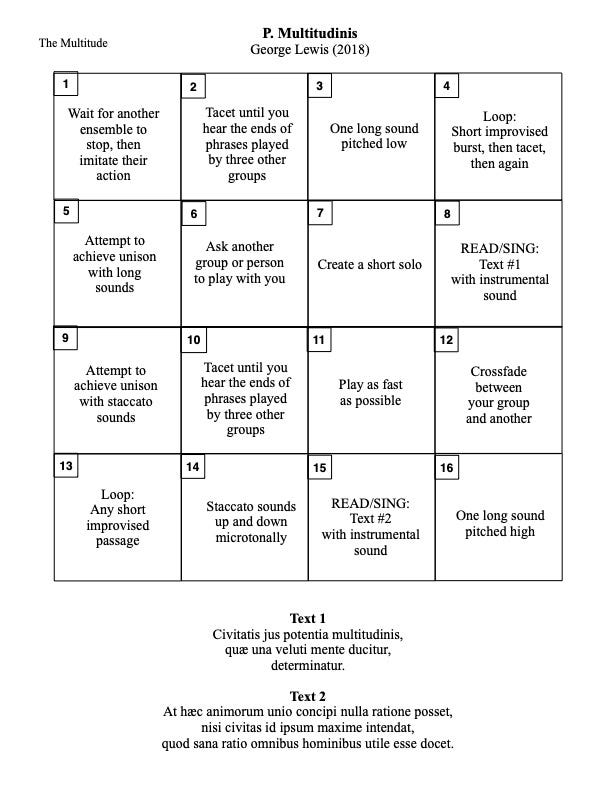
These examples present three different dimensions to radicalism: financial, organizational, and artistic. What they have in common is introducing democracy into the labor and ownership of the orchestra itself. A truly revolutionary project would involve all three.
Actually Existing Orchestras
In the U.S. there are several conductorless models (Orpheus and A Far Cry prominent among them), but the most promising ensemble in the country is without a doubt the Saint Paul Chamber Orchestra. This is not a measure of ideological extremism; there are other ensembles that are more aggressively political, for example. What’s notable about the SPCO is its material success. The Twin Cities are the only metropolitan area in the country that supports two full-time unattached professional orchestras, even though they are the 16th largest such area. This is in large part due to the radical vision of the SPCO. Without a Music Director (or permanent conductor) since 2003, they employ a model that combines a much higher degree of democratic participation that includes musician leaders with substantial artistic control. When they ditched the conductor, they also slashed ticket prices, opting for a ‘donor-first’ revenue model. This might seem like a recipe for ceding control to the donors with the deepest pockets, but the opposite has happened. The SPCO treats its entire audience as donors or potential donors. By drawing in younger audiences and soliciting smaller donations from larger numbers of people, they’ve developed a healthier and more robust balance sheet. It’s long been normal (at a time of declining audiences) for the SPCO to not only sell out shows, but to attract younger and more diverse crowds than practically any professional ensemble in the country.
The relationship between audience and orchestra is also transformed; it is typical for musicians to interact directly with audience members during and after shows, soliciting feedback and building relationships. The democratic ethos informs all aspects of the mission and the performances alike. The SPCO’s community presence in the Twin Cities is not to be understated: they’ve built a cultural institution that goes well beyond the traditional boundaries of orchestras.
One particularly interesting project is the Northside Celebration concerts that occurred until recently at the Capri Theater on Minneapolis’s historically Black north side. The orchestra joins local community leaders and musicians to present a mix of classical, gospel and spoken word. Importantly, the orchestra delegates extensive artistic control to community leaders, providing only musicians and resources to produce a concert that’s fundamentally of the community and for the community. The result is basically unrecognizable as an orchestral concert. The 2017 show was the only time I’ve been to a classical performance where the audience was overwhelmingly Black.
It is notable that the SPCO filled its audiences and its coffers by implementing a democratic model. The more important point, though, are the even more radical possibilities implicit in this story. The SPCO is able to experiment with risky projects because they’ve spent decades forming relationships with their community, which is the same as their donor base. Basically, the audience trusts them. That legitimacy allows and even encourages them to go beyond a narrowly defined mission. Throw a rock in a city and you’ll find an arts organization with a radical posture. Professional orchestras offer a level of structure and a bedrock community importance that these groups could only dream of. Because of the unique artistic and labor structure of an orchestra and its adjacency to civic life, it has a much greater potential for political organization than it might have seemed at first glance.
Orchestra as Dual Power
In the past decade, the orchestral world has been roiled by the broader political environment. Due to the intense culture of hierarchy, some of the most appalling instances of sexual abuse and misogyny unearthed during #metoo have come from the symphonic world. After the racial uprising in 2020, the call to modernize programs has been taken up across the country. The project to play marginalized composers, bring women into musical leadership roles, and diversify orchestras is in full swing. But these efforts—focused largely on optics and representation—miss the true potential of the organizations themselves.
What are some other uses for this institution? Orchestras, which are no stranger to labor actions and strikes, can be used as a megaphone for other labor activity. They can work in concert with other unions to message to the community and win the public over to the side of organized labor. Many orchestras rent the halls they play in, but a few own them outright. The spaces can be used for purposes of political organizing or education. Other assets often include tour busses and in-kind donations (i.e. old cars, legal services, etc.). The question isn’t the means but the political and organizational capacity.
Democratizing the SPCO strengthened the financial health of the organization, and it made the musicians and the community more active in the governance and direction of the ensemble. Both of these things amount to a type of consciousness raising, as musicians gain awareness of their class interests and audiences begin to understand themselves as a community, not just individual consumers. Oher ensembles should seek to follow suit. Right now, rampant financial difficulties and an alienated workplace make militant union action unlikely. But the AFM has a longstanding history of labor militancy that has ebbed since the second half of the 20th century. Rebuilding the power of the orchestra itself would open the aperture for the conceivable political activity. Once upon a time, boycotts and strikes against the recording industry brought Hollywood to a standstill, and musicians held the line for years to ensure long-term compensation for their work. A newly energized musician’s union could wield its power in more diverse ways, building politically engaged arts networks, joining ongoing fights against ICE, and offering basic community services. It might seem like a stretch to look to the Black Panthers’ ‘Survival Programs,’ which included clothing distribution, legal aid, and most famously, free breakfast for children. These are endeavors you’re more likely to see in a local library, maybe, but there are clear similarities between the two. Both operate in large public spaces and have a civic mission. It is only a deficit of imagination that prevents orchestras from serving a more expansive community function, especially at a moment when that function is rarely served at all.
Collective bargaining has long resolved around issues of compensation, but a first step would be to include the democratization and even musician ownership of the orchestra in routine demands. Conductors, who are compensated at rates up to 20x the wages of musicians, must justify their worth to the orchestras. Musicians might consider the possibility of existing without a music director, or else find ways to fold conductors into the broader mass of musicians. All orchestras should be doing the work to evolve from niche cultural organizations to institutions serving the communities they exist in. Part of that is responding to local needs and desires. The Elgin Symphony (a group I am a member of) has in recent years brought in Mariachi bands and traditional Mexican dancers that have performed alongside the orchestra to sold out crowds (I might mention that Elgin, a Chicago suburb, has a large Hispanic population). It might seem like a modest starting point, but labor movements rely on community support. Developing popularity within those communities (especially from the working classes) is a prerequisite for anything bolder.
The revolutionary potential of the symphony orchestra is to fulfill the role implied by their centrality, longevity, and their longstanding unionized workplaces. The first step is necessarily to build that legitimacy and presence in the community. From there, the orchestra becomes a node from which all sorts of things can happen. The potential for laboring musicians themselves to manage and direct the subsequent activities is the truly exciting possibility. In truth, organizations like the SPCO have barely scratched the surface.
I am writing this for the Do Not Research blog, a community that trends much more toward the visual arts than the musical ones. Nevertheless, the analysis should be easily portable across a number of fields. For one, very few people make a living off selling the art they make to private buyers. Even successful artists maintain side hustles (or main hustles) in adjacent work performed for a wage (for instance: design, advertising, technical jobs, etc.). As mentioned in the introduction, the arts have long drawn the most radical contingents of a society. But sometimes the most radical thing one can do as an artist isn’t necessarily to make the most edgy work but to unionize their restaurant job. The idea behind calling visual artists ‘middle-class’ isn’t to cast aspersions, but to set some parameters. Power comes from leverage, and the power of an orchestra, for example, comes from the organization of its labor and its position in the community. It is from this material reality that the possibility of a vanguard orchestra emerges, one with a truly revolutionary objective. After all, what is a rapt audience of 1000 spiritually hungry people if not a wonderful opportunity?
 | A guest post by
|