
Sea Monsters as Medium
The Bloop Case Study

Yuchin Chen is an artist and writer based in Berlin.
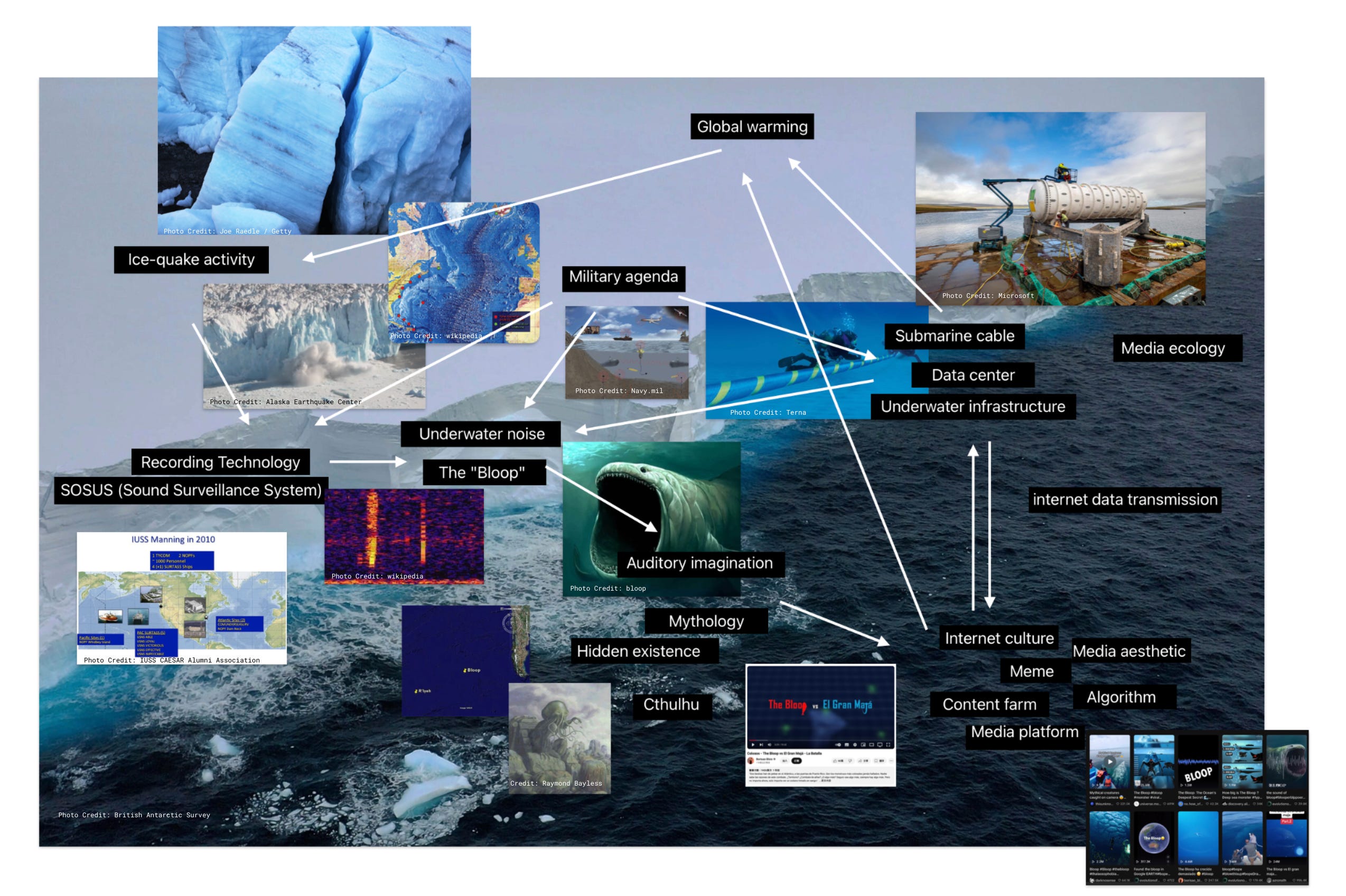
The “Bloop” an underwater recording from 1997, attracted certain attention from both scientific and supernatural, cryptozoology communities. The sound was recorded by NOAA (the National Oceanic and Atmospheric Administration) using the SOSUS (Sound Surveillance System) hydrophone network, originally developed by the U.S. military during the Cold War to detect Soviet submarines. The recording captured a massive, ultra-low frequency sound spanning a distance of over 3,219 kilometers.1
According to NOAA seismologist Robert Dziak, the original sound was a frequency rising lasting about one minute.2 The version circulating online is a 162k wav file, processed at 16 times its original speed, which raises the pitch and makes the sound more like a “bloop”.
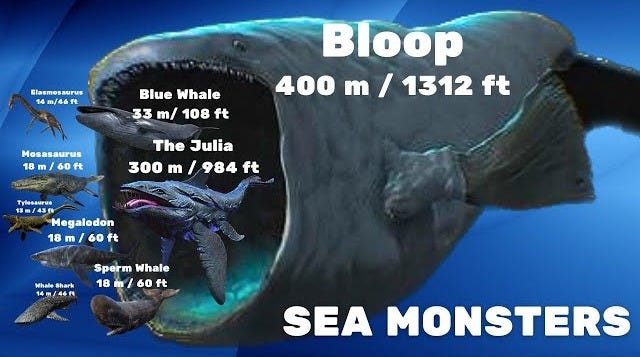
Perhaps due to the organic, eerie—or even ‘cute’—quality of the sound, and its amplitude, which was far greater than that of the largest known marine creature, the blue whale, many speculated that the sound came from a massive, unknown underwater being. Adding to the theatrical background, the sound’s geographical source was calculated near the South Pacific’s coordinates of 50° 0′ 0′′ S, 100° 0′ 0′′ W, west of the southern Chile. This location is close to the fictional lost city of R’lyeh from H.P. Lovecraft’s Call of Cthulhu, where the famous ancient entity Cthulhu is said to be imprisoned. The coincidence (or not) added fuel to the theory that the Bloop was linked to a mysterious sea monster.
Years later, NOAA researchers compared the Bloop’s frequency spectrum with recordings collected in Antarctica between 2005 and 2010 and attributed the sound to an icequake caused by Antarctic glacier activity.3 The scientific explanation, however, did little to diminish the cultural fascination surrounding the Bloop.
Discussions about mysterious creatures or phenomena often fixate on the tedious debate over whether these creatures exist or not. However, the potential of researching undefined mysterious creatures lies not in proving their existence, but in understanding how they become projections of our imagination, and what they symbolize culturally, socially, and politically. The Bloop is an example that demonstrates how, although scientific research has demystified the phenomenon, its cultural and imaginative significance as a medium for speculation remained intact.
In 2017, a popular Reddit post titled Leviathans was uploaded by user ColdCoffee1775 on the NoSleep forum. The post, written from the first-person perspective of a member of a research team, describes an encounter with a sea monster during an expedition off the coast of Chile. The creature is described as: “It was massive. It had to be at least 500 feet in length. It was similar to a humpback whale in shape, but it’s head was rounder and it’s mouth was filled with sharp teeth like an orca’s. It’s side fins had webbed fingers, like some sort of primordial amphibian. The creature had to be some ancient survivor of a bygone era. At least it used to be. The creature itself was not the most terrifying aspect, however. The creature lay on its side. It’s eyes were glassy. I could see swarms of crabs and other deep sea creatures picking at it. As I moved the submersible sideways across the length of the leviathan, I noticed something that gave me chills. The mid-section of the beast was torn almost in half. Marks of what were all too obviously left by teeth of staggering proportions were clearly seen. The scars of a titanic struggle. The creature, as incredibly large as it was, had been killed by something much, much bigger.”4 Although the author doesn’t directly claim that the creature or its killer is the Bloop, the possibility is implied.
Then, in 2023, the YouTube channel Borisao Blois uploaded a CGI animation titled Colosos - The Bloop vs El Gran Majá - La Batalla,5 featuring a battle between the Bloop and another mythical sea monster, El Gran Majá. The video gained over 90 million views, and the visual depiction of the Bloop closely matched the description from the Reddit post—a massive whale-like creature with sharp teeth. After this video went viral, platforms like YouTube and TikTok saw a sudden surge in Bloop-themed content, ranging from Godzilla vs. Bloop cartoons to various Bloop simulation videos.
From the imagination of underwater recording to uncanny memes, the origin story of the bloop does not derive from traditional folklore passed down orally in a village or from a one-sided monologue by a terrified witness. Instead, it lurks in the corners of the internet, before being dug up and rediscovered by algorithms. It is a multithreaded phenomenon, a digital mythology of the Anthropocene—woven by cryptid forums, fan fictions, remix and parody videos, as well as large-scale copy-paste content farms.
This mythology is sustained by extensive infrastructure networks of servers, data centers, satellites and submarine cables that directly or indirectly drive climate change, global warming, and iceberg activities. Compared to the unknown underwater creature, the reality of climate change is even more invisible and disconcerting. Within the icequake recording of the “Bloop”, what is revealing what, and who is disclosing whom? This becomes a recursive question. What is the origin of the “Bloop”?
Jussi Parikka suggests in Deep times and media mines: A descent into the ecological materiality of technology that “media technologies are, in short, ways of making sense of the earth (surveying, visualizing, informationalizing, quantifying, modeling, simulating) as well as being enabled by it—from electromagnetic communications to the minerals we extract to make cars and computers work.”, media and geology are intertwined, feeding off each other.6 In the Anthropocene, ecology and culture cannot be discussed separately, and undefined creatures, as speculative narratives, reside at the intersection of ecological, cultural and media studies. As the Bloop “roams” the South Pacific online, vast amounts of data are being transmitted back and forth through the submarine cables, emitting their own low frequencies, and creating their own voices of sea monsters.
In the Bloop, we hear not just a climate phenomenon, an imagination of Cthulhu mythos, or internet artifacts, but also the submarine cables are cyborg sea serpents, and the hydrophones are tentacles of a giant monster. Sea monsters can be a powerful medium linking mythology stories, military agendas, undersea industry, climate change, internet forums and media platforms into a complex ecosystem, unfolding multiple narratives.
David Wolman, “Calls from the deep” New Scientist, June 15, 2002. https://www.newscientist.com/article/mg17423474-000-calls-from-the-deep/
Ian Steadman, “The Bloop mystery has been solved: it was never a giant sea monster” WIRED UK, November 29, 2012. https://www.wired.com/story/bloop-mystery-not-solved-sort-of/
NOAA. What is the bloop? National Ocean Service website, June 16, 2016. https://oceanservice.noaa.gov/facts/bloop.html
ColdCoffee1775. “Leviathans,” Reddit, March 17, 2017. https://www.reddit.com/r/nosleep/comments/5zubxo/leviathans/?rdt=54497
Borisao Blois, “Colosos - The Bloop vs El Gran Majá - La Batalla,” March 31 2023, YouTube, 10 min., 32 sec., https://www.youtube.com/watch?v=hedUAqopPBg
Jussi Parikka, “Deep times and media mines: A descent into the ecological materiality of technology” in General Ecology : The New Ecological Paradigm, ed. James Burton and Erich Hörl (Bloomsbury, 2017), 170.
How cyclonopaedic