

Andrew Lummus is a writer based in Philadelphia & Delaware.
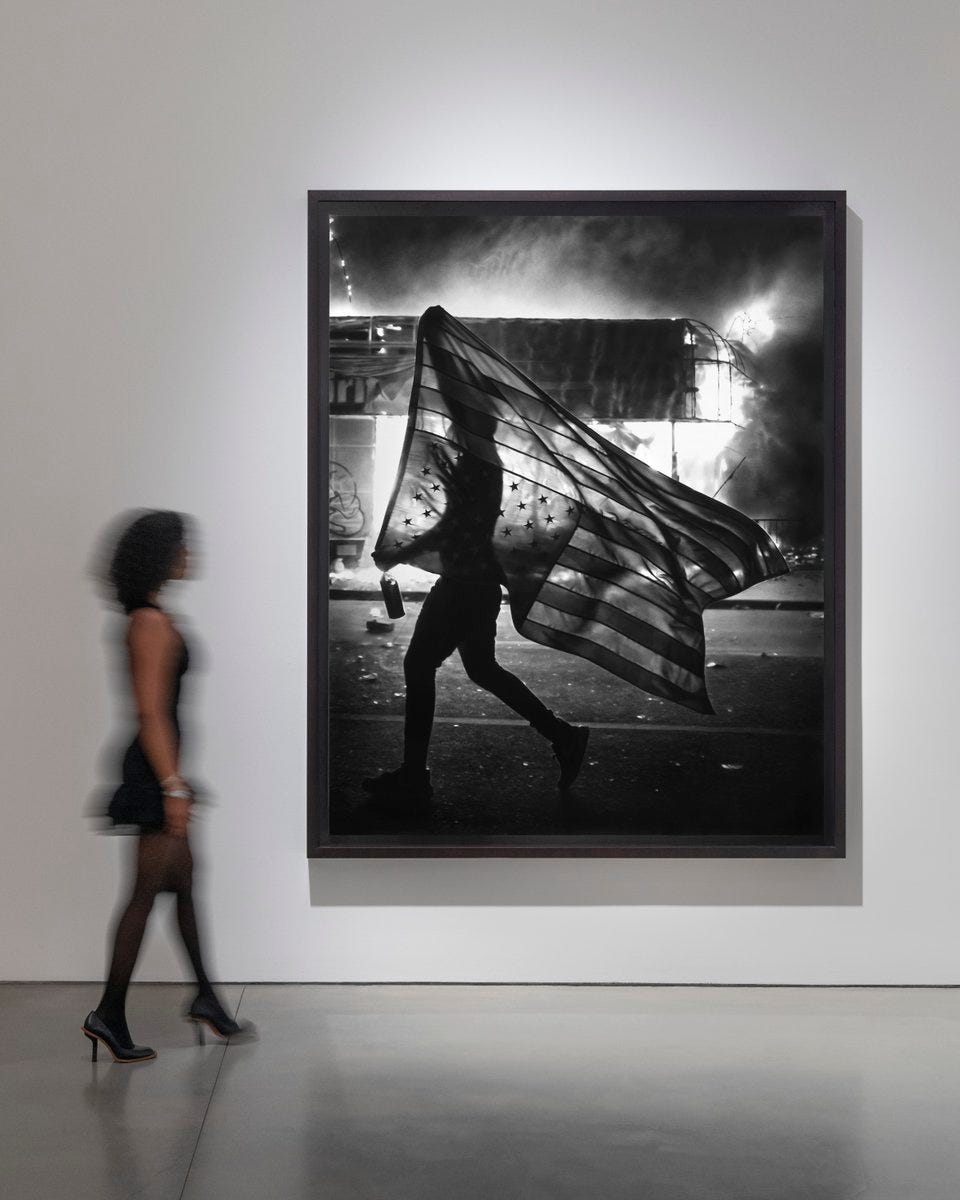
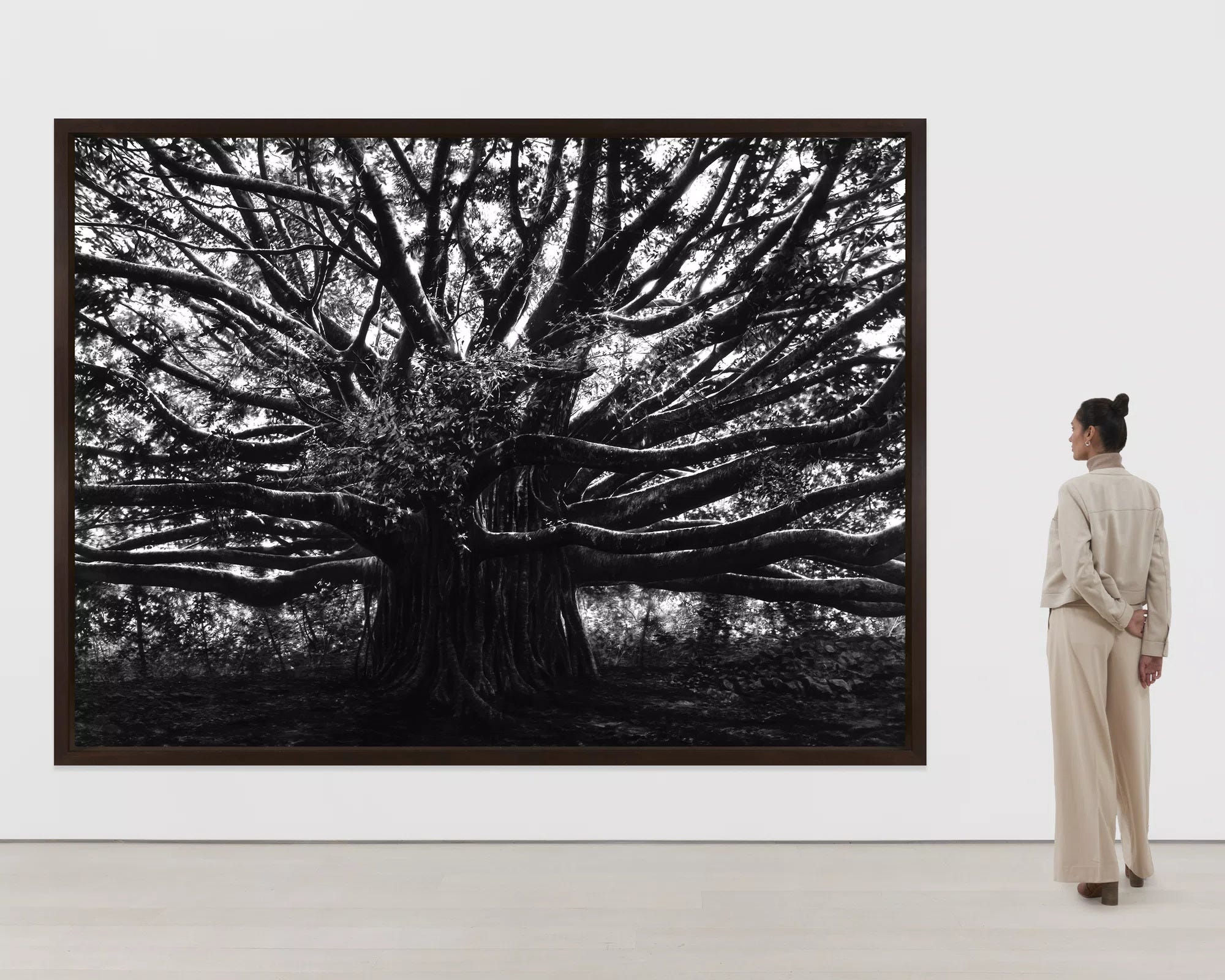
This past year, American artist Robert Longo mounted an expansive solo show at Pace Gallery in New York titled “The Weight of Hope.” The gallery displayed massive, gorgeous black-and-white drawings that mostly reproduce politically-charged photographs and film stills from the past fifteen years. While technically impressive, the images seemed politically sterile, and I was struck by the frank admission of their ineffectiveness by Pace founder Arne Glimcher:
“This Robert Longo show probably wouldn’t be taken by a museum today. It’s all about what Trump has done to our country. I think we have to fight it, and we have to make shows that are conspicuous, that get us in trouble. I was hoping for more trouble for this show than we got.” (i)
In my first reading, I understand some kind of disappointment in—which betrays a belief in the social function of—institutions to practice social critique. This reflects Glimcher’s generation’s belief in the power of commercial goods to affect political discussions, a belief that may seem strange. Glimcher would probably, fairly, anticipate and dismiss this criticism. As much has been said about Longo and his peers for decades, and their political advocates would likely argue that the potential social change in the given art-object vehicle outweighs the cost of critique’s neutralization. But there is still a clear acknowledgement that this desired “trouble” was not generated, and I contend it is not through a failure in subject matter nor execution, but in a methodological difference drawn by advancing technology over recent decades.
This older generation of artist and dealer, coming from the postmodern 1980s, does not understand the epistemic changes in visual culture since the advent of the internet and livestreamed violence. The sterility of Longo’s show reveals an inadequacy, inherent to his method, to speak to the ultracontemporary. To explain this, I will show why Longo’s recent works fail a more conventional reading, and then look at some of the underlying assumptions in these conventions of media theory to examine how times have changed. By briefly examining the history of some of Longo’s more infamous works with real-world violence, I will suggest new parasocial logics governing the relationships between viewer and viewed, between artwork and audience. This ties to the new framework of neo-orality, recently explored on the New Models podcast through the writings of Jacqueline Fendt, whereby the loss of consensus reality and abandonment of objectivity in the social media age inverts the historical Western move from an oral to a textual society, with corresponding epistemological changes. Here, I suggest that like text, images can work as fixed reference points to an external reality, whether or not that reality is real, and the stability of these sources has come into question in the age of the doomscroll. Can an art that relies on such twentieth-century fixed images still critique politics that are played out in a different arena?
Many are now familiar with the political failings of the critical postmodern artists of the 1980s; Longo himself acknowledged in 2003 that, “I had an ego that was totally out of control… I wanted to take an aggressive position in a culture that I thought was sick… In hindsight, one risks becoming what one critiques.” (ii) Yet, more than twenty years on, Longo has returned to that bombast to criticize the Trump administration, with Glimcher acknowledging, “I would like the agencies in the government to take note of what we are doing here. We have the First Amendment on the windows of this show.” (iii)
It may strike younger or more cynical readers as quite obvious that these postmodern retreads would be politically ineffective. Alex Greenberger, in his review for ArtNews, quite effectively pinpointed that the show was so painfully on-the-nose, and at times even deceptive, that it did little to dispel the notion that;
“Longo used to be a more thoughtful artist… the works tell Longo’s intended audience what it already knows: Something is rotten in the state of America. If you are interested in what is rotten and why it’s rotten—and all the nuance that goes along with that—you’d best look elsewhere.” (iv)
Critique is itself essential to the preservation of the American political system. Longo’s show would always have been allowed for its social utility of inoculation-via-critique. Governments tolerate and even foment critique to defang a controlled opposition and manufacture moral permission for their own censorious capacity, a default policy for liberal democracies through the twentieth century, though one more tenuously held by the current administration. The lack of “trouble” points not to tolerance by the government, but apathy. The Trump administration frequently makes a show of addressing and combating critique; this show, in New York, with a famous artist, at a mega-gallery, was not even on their radar. Was this due to the general political irrelevance of contemporary art, or because the type of critique in this show was not itself dangerous?
Longo has traditionally built his work from photography and film stills, two mediums which imply discrete temporal bounds. Particularly given his work’s relationship to the aestheticization of violence, this implies that the overwhelming saturation of the documentary image numbs us to the visceral reality depicted within. But times have changed, and violence is now livestreamed daily from warzones and hostage scenarios and university shootings to an audience searching desperately for immediacy. These records are often unverifiable, misdated, heavily edited, AI-altered, and so on. What matters now is not that the violence overwhelms us, or even that it is real or well-explained. Rather, the neo-oral subject seeks to invest themselves in the event, to react to it, to accumulate, evaluate, and redistribute vibes in a post-truth attention economy. Doomscrolling and livestreaming are the new meta, and the temporal indeterminacy implied by the epistemological death of the photographic documentary mean that just like violence, political critique must take a new vibes-based position if it is to cause trouble. By analyzing the relationship between Longo’s Guernica Redacted (2014) and real-world shootings, we can see how this technological shift has left Longo behind, thus why his Pace show was so politically toothless, and what it suggests for political critique in contemporary art.
Longo’s work works best when he is able to create a distance between subject and artwork, when the reproduced medium of film or photography, through overwhelming scale or repetition or unreadability, is able to engender disaffection. This disaffection is what draws us inwards, to interrogate our own assumptions and relationships to visual culture. These successes were described by Craig Owens;
“Longo’s images resist ambiguity; they might, in fact, serve as emblems of that blind confrontation of antithetical meanings which characterizes the allegory of unreadability. Suspended in a static image, a struggle to the death is transformed into something that ‘has all the elegance of a dance.’ Yet it is precisely this ambivalence that allows violence to be transformed into an aesthetic spectacle in photographs and films, and on television.” (v)
But what are the epistemological conditions for that internal transference to occur? We must take the film stills and photographs that Longo works from to be documentary of a reality that firstly is external to us, and secondly that we can become numb to through exposure. He engages these conditions directly in his censored reproduction of Pablo Picasso’s Guernica (1937).
Large black bars intervene in the wide expanse of Longo’s charcoal copy, which rather than engaging with the political newsprints Picasso was reading at the time, reference wartime film reels and omissions in the coverage of violence. This treats the documentary technologies, of film, of newsprint, or even of master copies, as factical, and led John-Paul Stonard to conclude that, “A sense of brutality lies at the heart of Longo’s approach to historical witness.”vi Two perforations mar the otherwise-smooth surface. As Longo explained;
“Guernica Redacted went to a museum in Germany and then to a museum in Ohio, the Wexner Center. When the museum was closed, a disgruntled security guard came in and started shooting a bunch of art. He put two bullet holes in the drawing, and then shot himself in front of it. So, Guernica still provokes.” (vii)
This intervention is itself not just a puncture, but a punctum, after Roland Barthes, where the artwork reaches into the viewer and provokes, unsettles, wounds. The viewer, in this case, returned that unto the art object, thereby completing the work and leaving it behind, scarred, as a piece of evidence. Our understanding of it is now constrained by this closed loop of meaning, which is quite friendly to Longo’s mythos, but does not allow the artwork to speak forwards into ultracontemporary times of conflict. It is, essentially, frozen in time as a frame in this finite, film still, roll-credits image culture.
Consider the act of this security guard, which was apparently unwitnessed. Could this have happened today? A contemporary subject, desperate to transact in vibes and reactions, might be unable to keep this to themselves; reality is now a construct of our own fluid digital projections. Hal Foster noted, in reference to Andy Warhol’s car-crash pictures, “even as he or she may mourn the victims, even identify with them masochistically, he or she may also be thrilled, sadistically, that there are victims of whom her or she is not one.” (viii) In the age of IRL streaming, this self-insertion has developed into full parasocial relationships. If this security guard carried out this act today, he might not have been so compliant to Longo’s chosen media and “completed,” so to say, the art object with perforation. He might have livestreamed it, like Brenton Tarrant Facebook-livestreaming a 2019 anti-Muslim massacre in Christchurch, New Zealand, or disgruntled right-winger Steven Righini, with his young daughter hostage, posting videos explaining himself during a 2025 police shootout in Maine. Death is no longer an end-point; someone else has to pick up your phone and end your livestream. To exist is not to leave a stable record of oneself, but to be logged-on and witness.
Many readers will have unwittingly encountered a horrific act of violence livestreamed online, taken from its context but as an island of visceral realness in a sea of slop. I saw clips of Tarrant’s massacre briefly on Twitter, before they were taken down. The first-person perspective made me think I was watching clips of a video game or training exercise. In the case of Righini, one of his videos automatically played while I was scrolling on X, his swollen, reddened face pleading with his family members to understand his actions, apologizing for what he had to do. Then, a hard cut to the next clip, a still image of the Thing from Marvel’s Fantastic Four, serenaded by Supa King’s refrain, “If I beat that pussy up, is you gon’ tell on me?” As Greenberger determined of the film component to Longo’s show, “If editing images together in such quick succession that they appeared to strobe incomprehensibly is a metaphor for the rapid-fire nature of our present media environment, it’s a tired one.” (ix) Longo’s interface with saturated image culture, and his finite sense of temporality, has grown old because our attention spans have caught up. So, we are looking for a more immediate form of visual storytelling into which we can insert ourselves. Whether or not these clips are perceived as real or fantasy, and perhaps even moreso if the latter, they provide an avenue for vicarious self-insertion, as Foster noted of the punctum’s voyeur. Precisely because these livestreamed records of violence are historically unstable, prone to deletion, partial censorship, and AI alteration, our oral recollections of seeing them are more powerful than the media itself. This is a turn to neo-orality, a kind of vibes-based post-truth epistemology that seems to correspond more closely to Longo’s more interesting early work than the recent Pace drawings.
For example: The first person I ever saw die online was a Russian ambassador, shot during a press conference. I encountered this video the day after the shooting occurred in December 2016. I was a high school student scrolling on Twitter and this video was next up. I did not read the caption. Of course, I was horrified when I realized I had just witnessed a man’s death. What stood out to me most was the disjointedness within the video, which was both visual and mental, as I suddenly understood what I was watching. The unremarkable calm, followed by the ambassador’s shoulders crumpling and the confused expression on his face, followed by the gleam of steel and fervor in the shooter behind him. Longo actually has commented on this very shooting: “Recently – it was very sad – the Russian ambassador in Turkey was shot, and people texted me and said it looked like one of the Men in the Cities. He was the right age, he was wearing the right clothes, the right haircut.” (x) And in the moments before I realized he had been shot and after, trying to understand if this was a clip from some show or skit, I experienced that same ambivalence and unreadability that Owens highlighted as the success in such early Longo pictures. I trafficked in vibes and reactions rather than textual, stable meaning, because until I saw the Associated Press pick it up later that day, I could not know the reality of the media I was observing. “Truth” was being manufactured by vibes-based intuiting from competing, unreliable sources on my For You Page.
Compare this to Longo’s show at Pace, with its well-attributed, occasionally-altered but factual source images from events we all remember from the news. There is nothing truly dangerous about this, not because its political claims are unspecific, but because it fails to engage with images of violence on the level at which they are nowadays distributed; it does not actively engage with our vibes-based attention economy. We do not look to images for their veracity, a veracity which can be blurred and question through postmodern techniques of repetition or decontextualization. This very veracity is no longer interesting, because along with the breakdown of consensus reality, we use our familiarity with postmodern media techniques to “vibe-out” the nature of something through performance and reaction rather than deduce a series of facts. The Trump administration is well-versed in post-truth communication, providing the template for an entire media ecosystem and new age of politics. Consensus is no longer achieved through logical deduction and good-faith debate, but through mirroring the correct patterns, reacting the correct Pepe, accumulating aligned vibes. Failing to make a political critique in the appropriate ultracontemporary method dooms one’s efforts, and partially explains why Longo’s show, and more generally, political contemporary art seems so toothless and irrelevant. If artists want to truly rock the boat, art needs to catch up.
"This Robert Longo show probably wouldn’t be taken by a museum today. It’s all about what Trump has done to our country. I think we have to fight it, and we have to make shows that are conspicuous, that get us in trouble. I was hoping for more trouble for this show than we got."
This profoundly affected me...