
Performing Distress
Online DID Faking and the Logic of the Hysterical

text by Bridgit Phillips
Strange online behaviors often mirror patterns long present offline, amplified by digital platforms. Phenomena like Dissociative Identity Disorder (DID) faking, while a bizarre and excessive symptom of internet life, enacts familiar social logics long observed in historic expressions of the hysterical, including the performance of culturally intelligible distress, the formation of intense social bonds, and the contestation of institutional authority. When considered through the lens of the hysterical—as established in historical, anthropological, and psychological perspectives—what appears anomalous is really a traceable response to the current cultural moment, reflecting the commodification of identity, atomization of community, and suspicion of expertise.
Building on interdisciplinary understandings of hysteria and its core social functions, in this essay I use ethnographic material gathered in 2025 from the subreddit r/SystemsCringe to show how DID faking follows a recognizable hysterical logic. Seen in this way, online DID faking appears less as an anomaly and more as a coherent response to the conditions of the present, embodying defining features of contemporary life. Extreme phenomena like online DID faking, while on one hand performative and irrational, are often an expression of established social logics that can tell us the most about the conditions that produced them.
Hysteria as a Moving Cultural Framework
Hysteria is best understood as a recurring social logic that adapts to dominant threats, information environments, and structures of authority. Throughout history, behaviors labelled as ‘hysterical’ have shifted in form and explanation, not because the underlying dynamics disappeared, but because each era rearticulated them within its own vocabulary. As Bartholomew and Wessely note, hysteria “flourishes where the threat has a basis in reality”1. What counts as a threat and what reality looks like, changes with time and context.
In the Greco-Roman world, hysteria was famously explained through the metaphor of the ‘wandering womb’ reinforcing assumptions about female instability and sexual deficiency. During the Middle Ages, similar behaviors were recoded as demonic possession or witchcraft, shifting explanation from bodily dysfunction to moral and spiritual corruption.
By the Renaissance, the hysterical was increasingly located in disorders of the brain rather than the soul, reflecting a broader centering of scientific thought, and laying the groundwork for the later development of psychiatry.
In the twentieth century, hysteria became Mass Psychogenic Illness, marking a “shift in attention from the individual to a collective hysterical body”. Anxieties produced by industrialization, chemical warfare, and technological threats produced hysteria based on fears of environmental contamination: tainted food, polluted air, unidentified odors. The content of the symptoms changed, but the structure remained consistent: collective distress circulating through socially plausible danger.
Digital Hysteria
If hysteria has historically adapted to prevailing threats and information systems, its contemporary expression is inseparable from the digital media environment. The current cultural and communication landscape amplifies susceptibility to social contagion. The fundamental alterations in communication brought about by social media have shaped how distress spreads, producing what researchers now describe as Mass Social Media Induced Illness. Whereas previously, physical proximity was thought to be required to spread episodes of hysteria, it has now been established that contagion can be spread by digital exposure alone.
In 2019, a young German content creator, Jan Zimmerman, gained popularity with a YouTube account Gewitter in Kopf, which documented his life with apparent Tourettes syndrome. Experts had confirmed the tics were not the result of Tourettes, and major support organizations for the disorder distanced themselves from Zimmerman, claiming his content was providing an inaccurate portrayal of the disorder. Within 3 months, he had over 1 million subscribers and was the top breakout creator in 2019. His rise in popularity was accompanied by a sharp increase in presentations of Tourette’s-like tic symptoms in young people in Germany, with no history of Tourettes, which is diagnosed in childhood, and not meeting diagnostic criteria for the syndrome.
Researchers internationally have now found evidence of a significant rise in presentations of sudden-onset, complex, and significantly disruptive tics with atypical and non-diagnosable features, attributed to social media consumption6.
In a predominantly online environment, distress is performed, monetized, and validated through visibility. Social media collapses boundaries between private suffering and public identity, allowing culturally recognizable symptoms to circulate at unprecedented speed, enhanced by the social capital gained by performing suffering in a culture that centers trauma.
Cultural Meanings of the Hysteric
Anthropologically, hysteria has been thought to perform three core cultural functions, which recur across historical and social contexts.
Firstly, it is a culturally shaped expression of suffering: a means of articulating otherwise inexpressible psychological or social distress using the idioms, symptoms, and narratives made available by a given cultural moment. Because hysterical symptoms are psychosomatic and socially contagious, their form reflects prevailing anxieties, making hysteria a mirror of collective fear.
Secondly, hysteria operates as a mode of social bonding and identity formation. Shared symptoms, specialized language, and ritualized practices create communities organized around mutual recognition, transforming often marginal or stigmatized experiences into sources of belonging and meaning. In this way, hysterical formations produce social spaces in which individuals define themselves in contrast to dominant norms and sustain relationships through shared affliction.
Finally, hysteria has long functioned as a challenge to authority, particularly medical, political, and economic. Anthropological accounts describe how episodes of spirit possession among women working on Malaysian factory floors expressed refusal in exploitative labor environments7. Similar dynamics appear in descriptions of nevra among Greek immigrant women in Montreal, where psychosocial symptoms gave voice to the pressures of industrial labor, gendered expectation, and economic precarity8.
Taken together, these three meanings position hysteria as a culturally sanctioned mode of expression, community creation, and resistance, that repeatedly re-emerges in new forms as social conditions, information environments, and authority structures change.
The Online DID Community
The online Dissociative Identity Disorder (DID) community is an expansive digital ecosystem across thousands of Discord servers, Aminos, YouTube channels, subreddits, and TikToks. Self-identified DID creators document their daily lives, relationships, and symptoms to audiences numbering in the hundreds of thousands or more, often monetizing their content through advertising and subscription platforms. There are over 7000 Discord public servers tagged ‘system friendly’, and thousands more private. As of May 2023, videos with the hashtag #DID have been viewed a total of 2.7 billion times and #dissociativeidentitydisorder videos had been viewed 1.5 billion times (TikTok no longer publishes information on the view count per hashtag)9. Like many internet subcultures, the DID community operates less as a single group than as a constellation of micro-communities, each with its own norms and leaders. Many individual communities are closed, requiring referrals or selection, proliferating the sense of belonging when one ‘makes’ it in.
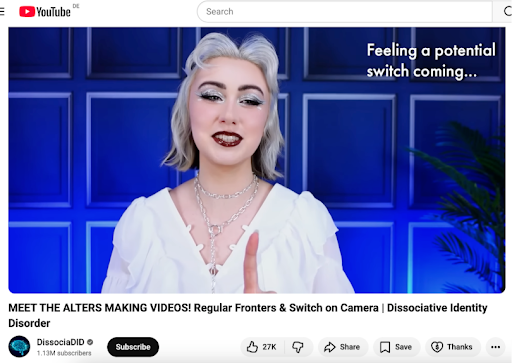
Members use specialized vocabulary: describing themselves as “systems,” composed of multiple “alters,” each with distinct personalities, roles, and histories. Alters may be “fictives,” based on fictional characters, or “littles,” child personalities that require protection. The “host” is the alter most frequently in control, while “fronting” refers to which alter is currently active. Systems typically refer to themselves collectively as “we”. In many communities, self-diagnosis (“self-dx”) is widely accepted and often encouraged.
r/SystemsCringe
Given the breadth of this landscape, I focus on a single node: the subreddit r/SystemsCringe. Unlike pro-DID spaces, it is explicitly skeptical, bringing together users with personal experience of faking, or close connections to those who have, to document and critique alleged cases. By aggregating testimonies from across the wider ecosystem, the subreddit offers critical awareness of the inconsistencies and dangers of faking, alongside an understanding of its appeal, making it a valuable site for observing how DID identities are performed and policed.
I spent one month engaging with r/SystemsCringe as both a passive observer and an active participant. I identified myself as a researcher and invited users to share their experiences, particularly those who had previously identified as fakers or had been closely involved in DID communities.
Rather than evaluating the authenticity of individual claims, my analysis asks whether the self-diagnosis and performance of dissociative identity disorder operates as a modern hysterical formation.
Across my observation of and participation within r/SystemsCringe, a recurring theme was that individuals labelled as ‘fakers’ were experiencing genuine distress, and DID provided a socially intelligible explanation for this. One user stated that “having a disorder like DID gives them an ‘excuse’ to behave erratically” (anonymous user, direct message). Another reflected: “I was going through a rough time, and I didn’t feel like I was good at anything or important to anyone. ‘Having’ these disorders was a way to make me feel special, interesting, and valid” (anonymous user, public post).
Several participants emphasized that faking was not always a conscious or malicious act. As one user explained, “A lot of people are not intentionally faking. Whether it be dissociative PTSD [Post Traumatic Stress Disorder], BPD [Borderline Personality Disorder], or just general dissociation, many people will want to find answers for what is wrong with them and end up convincing themselves that they have DID” (anonymous user, direct message).
Beyond individual expression, participants consistently emphasized the sense of belonging these spaces provided. One user remarked, “A lot of what I’ve gathered is people do it for community—the community around these disorders is very tight-knit, they all watch for each other and it’s almost like a club”. Another similarly concluded, “I think they really just wanted a sense of community”. Adopting a DID identity functions not only as an explanation of personal distress, but as an act of community affiliation.
Community leaders and members actively encourage identification with the disorder, reinforcing boundaries between insiders and outsiders and the community identity. One user noted, “If you ever questioned if you had DID, immediately you would have people telling you that you had it” (anonymous user, public post). Another reflected on the difficulty of disengaging: “Every time I was close to getting out of my faking, the people on the server would convince me I was a system” (anonymous user, public post). The community itself becomes invested in maintaining the disordered identity, as it is the primary basis for social cohesion.
This dynamic also reproduces a third defining feature of historical hysteria: resistance to institutional authority, particularly medical expertise. Discussions on r/SystemsCringe frequently described community leaders positioning themselves as more legitimate than trained professionals. One user recalled:
“The staff acted like they were better than psychologists and doctors. If the new owner said Partial DID wasn’t real, it wasn’t real, even though it’s in the ICD. If the new owner said OSDD1-A causes a system, it must be true, even if that’s not what the DSM says... The staff would also encourage people to ‘defrag,’ which meant making your alters even more distinct and separate. It was pretty much the opposite of integration/healing.”
This illustrates how online DID communities construct alternative regimes of truth, rejecting or reinterpreting psychiatric classifications in favor of internally generated standards. Clinical goals such as integration are reframed as harmful, while practices that intensify dissociation are encouraged, further distancing members from mainstream treatment.
The defiance towards medical authority also extends to diagnostic processes themselves. As another user explained:
“Everyone wanted to get diagnosed with DID, even though they were pro-self-dx. Several people shopped and lied until they got a DID diagnosis, even though they had been previously told many times by doctors that they didn’t have DID. The staff would also coach people on how to deceive their doctors to get a DID diagnosis.”
Here, self-diagnosis and diagnostic manipulation are functioning as acts of resistance, allowing individuals to reclaim authority over identity formation while rejecting professional gatekeeping.
Conclusion
At first glance, online DID faking can easily be dismissed as a strange product of internet culture, driven by misinformation and identity performance. Such an interpretation, while not incorrect, obscures the interesting elements of the phenomenon. When approached through an anthropological understanding of hysteria, DID faking appears not simply as a bizarre aberration of the digital age, but as a culturally intelligible response to contemporary conditions, that echoes the historical role hysteria has played for those positioned outside the mainstream.
The apparent strangeness of online DID faking is less a reflection of individual pathology than of the cultural paradigm in which it emerges. In a social world organized around visibility and performative authenticity, but marked by institutional distrust and social fragmentation, distress must be made legible through recognisable narratives to be acknowledged at all. The DID community functions as a space capable of recognizing and validating forms of distress that might otherwise remain unseen or misunderstood.
Historically, hysteria has surfaced most often among those whose suffering lacks an authorized language- women, laborers, and marginalized groups whose experiences sit outside dominant institutions and frameworks. The online DID community continues this pattern. Rather than signalling a departure from historical precedent, it demonstrates how hysteria adapts when institutional recognition is scarce and digital platforms become the primary sites through which identity is negotiated.
Fascinating. Thank you
So, so interesting! Really enjoyed this!