
Opening the Overton Window

Firuza Huseynova is a writer based in Montreal.
Is it more effective to carry out incremental (yet gradual) changes within the confines of a given system, or to push for disruptive (yet revolutionary) leaps if we wish to achieve progress?
According to Joseph P. Overton, father of the ‘Overton Window’, each societal group, from politicians to lawmakers to think-tanks to social advocacy organizations, has their own role to play in radically shifting or maintaining the range of socially-acceptable policies.
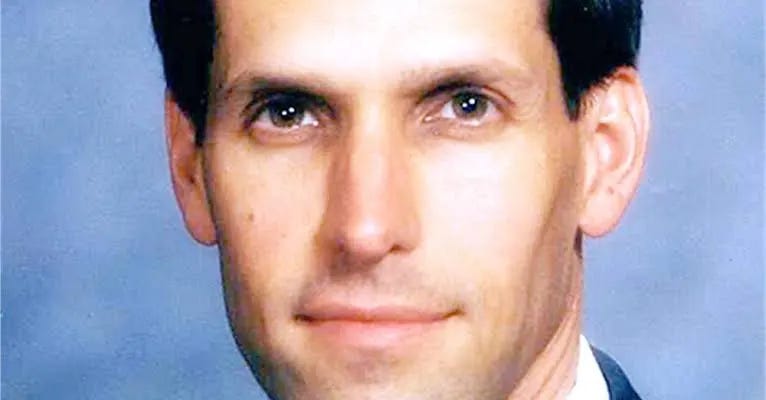
The concept of the Overton Window was developed out of the Mackinac Center for Public Policy in the mid-90s, and discussed regularly at Center seminars. It was first cited on broadcast television in 2009 by Fox News correspondent Glenn Beck1, who later published a fiction book creatively titled The Overton Window in 2013. Since then, it has been invoked by a wide range of publications, from The New York Times2 to The Christian Science Monitor3, in order to illustrate the movement of politically-safe ideas that the public is willing to accept.
Though little academic literature has been published on the Overton Window (aside from a handful of mentions in conference proceedings45 ), it remains a useful conceptual metaphor and analytical tool for anyone interested in social movements, political imaginaries, theories of change, and processes of legitimation.
Not much is known about Mr. Overton himself. A Michigan Native, he studied electrical engineering and law after high school, eventually being admitted to the state bar. Following in the footsteps of his father, Joseph Overton worked as an electrical engineer at the Dow Chemical Company until joining the Mackinac Center for Public Policy as a policy analyst in 19926.
Founded in 1987, towards the tail end of Ronald Reagan’s rule over America, the Mackinac Center for Public Policy aims to promote libertarian ideas such as lower taxes and stronger individual property rights. Over the course of the 90s, Overton worked his way up the think-tank, gaining enough influence to become the Senior Vice-President, and ended up sharing his abstract concept about political discourse with Mackinac Center President Joseph G. Lehman in the mid-90s [1]. It was a hit.
Today, the Mackinac Center is one of the largest free market think tanks in the world, receiving funding from a number of conservative corporations and individuals, including the DeVos family [6] (though the Center prefers the description ‘free market’ over ‘conservative’, ostensibly due to its non-partisan air). Most recently, the Center came under controversy for being linked to the now-infamous 922-page Project 2025 blueprint, which outlined an authoritative second term for President Donald Trump. According to Mackinac Center spokesperson Holly Wetzel7, they were approached by the Heritage Foundation to provide expertise on labor and energy policy, but ultimately did “not fully endorse [some ideas]” and requested their name be removed from the project (it may be pertinent to note that the Center’s director of energy and environmental policy is still listed as a contributor in the report [7]).
Joseph Overton passed away at the age of 43 after facing critical injuries while piloting an ultralight aircraft in 2003 [1]. Posthumously named, The Overton Window not only became the title of the Mackinac Center’s podcast on public policy, but also evolved into an influential concept for researchers across all axes of political division.
Like all successful concept handles8, the Overton Window aims to clarify an abstract social phenomenon that people sort-of understand yet cannot clearly discuss. And, as all successful researchers know, if you give a catchy name to a complex concept, it becomes much more likely to spark conversation and reflection among the general public. Thus, the Overton Window was opened.
The Overton Window states that within a given country, state, or organization, every political argument can be placed along the following spectrum of discourse: unthinkable, radical, acceptable, sensible, popular, or policy. Over time, the window of politically-acceptable stances on a given argument can shift — shrinking, expanding, growing, depleting — depending on how much political energy feeds it.
In an attempt to avoid the heavy baggage associated with the left/right political divide, Overton decided to arrange his window vertically, from ‘no government control’ (total freedom) on top to ‘total government control’ (no freedom) on the bottom [1]. Here, the libertarian influence of the Mackinac Center is clearly exhibited, as freedom becomes associated with liberation from the shackles of the state, and policies which may inhibit privatization (ie. strong labor unions, progressive taxation, expanded public welfare services) become negatively-connoted from the onset.
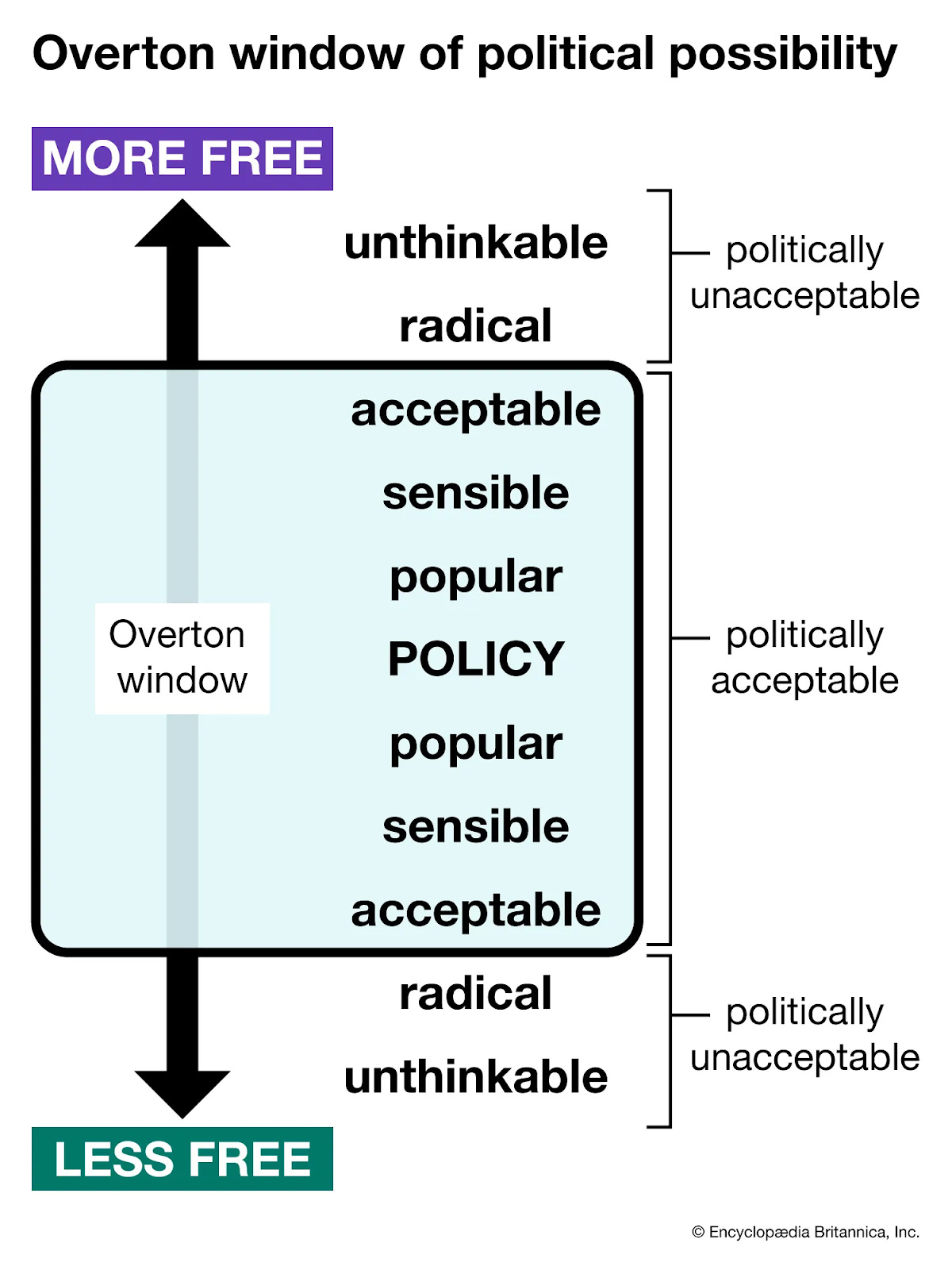
Libertarian leanings aside, any politician who supports policies that are outside the Overton Window today risks facing defeat in the next election. Ideas inside the Overton Window are considered politically safe, but ideas outside of it may be too radical for the public to accept.
As explained by Joseph Overton, while it is the duty of politicians to propose agendas within the confines of the Overton Window, it is the responsibility of think-tanks to promote policies outside of it, effectively shifting the Window in the direction that best aligns with their interests.
Other things which can shift the Window include media propaganda, the entertainment industry, and historical crises; simply, anything that gets an idea out in the open so it can be discussed and debated has the potential to shift the Overton Window.
In the 5 years since Do Not Research was founded, 9 authors have nodded to the Overton Window in published works, though none have yet defined the concept in clear terms.

Travis Hunnie9 turns to the idea to illustrate the distinct ethos formed in his student organizing group: “Our space had its own Overton Window, and as it shifted further left, we would emerge for increasingly risky direct actions; sit-ins and hard pickets were only possible because of the trust we developed in the safety of our own dark forest.”

From Sam Stewart10, the Window is used in reference to LARPing, which he claims “offers individuals escapism from political systems that alienate them and new political imaginations outside the Overton window.”
In Politigram & the Post-Left (the modern-day Magna Carta for doomscrollers), Joshua Citarella11 describes the ever-expanding range of acceptable ideologies to possess (collect?) in the ‘memo-sphere’, writing, “in a moment where mainstream political debate began to narrow into ‘what is realistically possible within the existing system’, the Overton window for these radical kids grew wider than ever.”
A common thread among these nods is a shared desire to transcend the limits of the narrow perceived Overton Window, to operate outside the confines of status-quo political possibilities, and to become an active agent in a world that is thrust upon you, even if your participation is illusory. Fisher12 had it right in 2009: we are grasping for autonomy within a capitalist system that insists there is no alternative.
In leftist circles, the Overton Window has typically been invoked to propose radical policies — not necessarily to achieve them, but so that slightly-less-progressive versions of those policies get put into action instead. The argument here is that the best way to shift the Window is to advocate for extreme positions which change the realm of political possibility, since once something radical has been floated, more moderate positions will start to look more acceptable.
However, throwing the most extreme versions of a demand out will not automatically drag politics leftward. In an article for Jacobin titled Let’s Stop Talking About the “Overton Window” (clearly I did not get the memo), Ben Burgis13 writes, “we have little reason to believe that proposing very unpopular ideas will do anything to make more moderate versions of those ideas more popular.” He gestures toward creeping normality: the slow, boring process by which ideas become acceptable because they stuck, not because they shocked.
Still, is there space for radical demands and quiet reforms to co-exist? Can two things be true at once?
We should co-opt the concept of the Overton Window to suit our goals, as long as we remember its roots in libertarianism, in binary abstraction, in linear efficiency. Progress is not bi-directional, nor do policies place neatly along a linear axis. In the same breath that a libertarian may attack a policy supporting more affordable healthcare for its reliance on the ‘nanny state’, they may also defend a policy deploying ICE agents to instigate mass deportations, or the U.S. invasion of Venezuela for the sake of state security. Right is right, up, left, down, none and all at once.
In a post-truth, post-trust, post-modern post-world, our Overton Window(s) become(s) much more localized, tribal and ambitious. As per highly-experienced political scientist Greg Guevara14, being in the middle of the Overton Window is no longer within the confines of the Overton Window. Online, extreme ideologies proliferate with far greater fecundity than their boring, lib-pilled counterparts. The openness of networked space allows for radical ideologies to latch onto people, rather than the other way around. In the absence of genuine political progress, humans become mere-conduits for ambitious ideas — unconditional accelerationism, anarcho-primitivism, mutual-aid maximalism, dark Enlightenment, the network state, etc. etc. etc. Perhaps we mix-and-match our metanarratives to awkwardly align with all of these ideologies, within the span of a week.
Yesterday, our window cracked open. We let the light in. If the sun bled through a touch too hot, we closed our window and turned our fan on.
Today, our window soars open. Chilled by the frost, we install a plastic covering to insulate ourselves. An hour later, the sun melts right through our protection. Unable to afford a new window, we sit in the blistering heat until it lulls us to sleep.
Tomorrow, our window may reappear, disintegrate, and rematerialize within a matter of hours. No matter the risk, we must continue opening our windows. If they break, we must be able to fix them ourselves.
Lehman, Joseph G. 2009. Glenn Beck Highlights Mackinac Center’s “Overton Window”. Mackinac Center for Public Policy Blog. https://www.mackinac.org/11398
Astor, Maggie. 2019. How the Politically Unthinkable Can Become Mainstream. The New York Times. https://archive.is/q8iv7#selection-499.0-550.0
McCutcheon, Chuck, 2019. How Trump and Sanders broke the Overton window. The Christian Science Monitor. https://www.csmonitor.com/USA/Politics/Politics-Voices/2016/0311/
Lopez, Juan, Kalyan Perumalla, and Ambareen Siraj. 2021. The Overton Window: A Tool for Information Warfare. ICCWS 2021 16th International Conference on Cyber Warfare and Security.
Amer, Sarah K. 2023. AI Imagery and the Overton Window. Computers and Society. https://doi.org/10.48550/arXiv.2306.00080.
Mackinac Center for Public Policy. n.d. Is the Mackinac Center for Public Policy Liberal? Libertarian? Conservative? https://www.mackinac.org/1663
King, Jon. 2024. Mackinac Center asks for name to be pulled from Project 2025. Michigan Advance. https://michiganadvance.com/2024/07/18/mackinac-center-asks-name-to-be-pulled-from-project-2025/
Alexander, Scott. 2016. Nonfiction Writing Advice: Use Strong Concept Handles. Slate Star Codex. https://notes.andymatuschak.org/z3b7sidNrEkNaY9qfGwZjwz
Hunnie. Travis. 2022. Dark Forests and Student Organizing. Do Not Research. https://donotresearch.substack.com/p/travis-hunnie-dark-forests-and-student
Stewart, Sam. 2024. There Are Cathedrals Everywhere, For Those With The Eyes To See. Do Not Research. https://donotresearch.substack.com/p/sam-stewart-there-are-cathedrals
Citarella, Josh. 2018. Politigram & the Post-left. Self-published. http://joshuacitarella.com/_pdf/Politigram_Post-left_2018_short.pdf
Fisher, Mark. 2009. Capitalist Realism: Is There No Alternative? Zero Books.
Burgis, Ben. 2020. Let’s Stop Talking About the “Overton Window.” Jacobin Mag. https://jacobin.com/2020/09/joseph-overton-window-bernie-sanders.
Guevara, Greg. 2020. Has The Overton Window Shifted Left Or Right? Youtube.
Great writing