
Artist Profile: New Models


NEW MODELS is a place. It was created by Caroline Busta and Lil Internet. Busta entered the legacy media world as an intern at Condé Nast before working as an associate editor at Artforum in New York and later as the editor-in-chief of Texte zur Kunst in Berlin. Lil Internet is a multi-media artist, music producer, and creative-director who early-on achieved social media notoriety. Both come from pop cultural backgrounds intertwined with old media structures. They would bear witness to those legacy models’ collapse.
Carly remembers that shortly before starting at Artforum in 2008, Damien Hirst’s diamond-studded skull work, For the Love of God, purportedly sold for $100 million dollars. And a few months after she arrived, the financial crisis hit. The ground beneath their desks started to erode. Lil Internet remembers, two years earlier, convincing a famous online streetwear retailer that putting free videos on YouTube was a good idea, realizing that, with the arrival of socially networked media, attention was all that was about to matter. Both Carly and Lil Internet sensed that the art and culture industry as they’d known it was underpinned by economic structures that were already starting to come undone. This terrain would continue to shift as our media landscape transformed.
As they define themselves, “NEW MODELS is a media channel & community addressing the emergent effects of networked technology on life. It seeks new frameworks for understanding the mess of the world and the ways in which the mediation of this mess shapes us.” Carly mentions the artists Dis and Bernadette Corporation as influential to her and Lil Internet’s early ideas for New Models. They asked themselves, “Can we create a space that makes smart people feel cool and makes cool people feel smart?” Carly recalls Juergan Habermas’s description of the public sphere, “a space that is conceptually distinct from the state, and a site for the production and circulation of discourses that can, in principle, be critical of the state.” Lil Internet declares that “the cloud” is not a place. New Models, to the contrary, would be.
In 2018, newmodels.io launched as a website featuring links hand-aggregated by Carly and Lil Internet from their own feeds and those forwarded by friends. The conceit was to mimic the layout of the US new site Drudge Report, which despite (or perhaps due to) having remained almost exactly the same since its launch in 1997, was, by the mid-2010s among the most visited in the US. The New Models’ site, which was given form by Jon Lucas and a logo by Eric Wrenn, was intended to provide users with a non-algorithmically governed portal to a certain scene or informational world without the need to engage with your social media feed. Looking back through the eight year archive provides a snapshot of the media environment Carly and Lil Internet selected from year to year. The first article they posted is James Bridle’s self-published text from 2017, “Something is Wrong on the Internet.”
As linear media’s dissolution hastened, Carly drew an analogy to a glacier calving off due to global warming. Commenting on the experience of users negotiating the network media that has superseded it, Lil Internet likened us to skydivers flying through a cloud “with all sense of scale and direction erased by an endless glowing fog.” We can imagine our current media landscape as a place that looks like heaven. Infinite clouds and each of them is perfectly unique. Everyone is connected in the hyperion social network, built by the most antisocial people on Earth, but it doesn’t matter anyway, because no one is guarding the gate. It has long ago been left open and Saint Peter is at home watching Italian brain rot TikTok while content creators float like polar bears on small, slippery chunks of ice down the river of the great melting glacier of legacy media.
“It was clear that the conversations we needed to have urgently about aesthetics and language that used to be the domain of critical art theory or critical cultural theory no longer had a space in legacy publications,” Carly says, speaking of the mid 2010s. At the same time, Lil Internet argues that the “physics” of the online space were severely warping critical discourse. “It felt like on one hand, if you were online, you were playing a bad video game and on the other hand, if you looked at traditional media outlets, you had no room to move. There were just no pathways.” As the flood waters rose around them, Carly and Lil Internet realized that they would need to build their own boat. “It was freeing.” Carly adds, “It’s like the Artaud quote– No one makes art but to get out of hell.”
From this maelstrom, NEW MODELS expanded from aggregation into podcasting. Their intention was to create a signal powerful enough to have influence within the attention economy but not be warped by its physics. The podcast was co-founded with artist Daniel Keller. During Carly’s tenure at Texte zur Kunst, she had commissioned Keller to create a “Timeline of the Alt-Fact” that plotted a genealogy of how networked digital media had changed the way we increasingly read signs and ultimately agree on “truth.” The first entry was Alex Jones registering the domain infowars.com in May of 1999 and the last was from a few weeks into Donald Trump’s first US presidential term, including, in between, such events as the 2013 creation of Cambridge Analytica and the fervently crowdsourced investigation of Malaysia Airlines Flight 370’s disappearance in March 2014: “For a brief moment it seems that Courtney Love has identified debris in a satellite image, but it ends up being regular trash”. Among the illustrations that ran with the piece, was Matt Furie’s original drawing of Pepe the Frog, an editorial decision that strained Busta’s relationship with the magazine’s publisher but made clear the limitations of exploring this new era via legacy media channels. Keller’s work, like other early contributors to New Models, Holly Herndon & Mat Dryhurst, and many others from Do Not Research, interrogates the splintered public sphere, what communities arise from its division, and the resulting effects on politics, economics, technology, and culture. From the podcast, NEW MODELS created a Discord channel to further interact with the community growing around its feed.
Not wanting to “play the video game,” to engage in mass hysteria at the peak of the alt-fact scold core Vampire Castle Twitter age, Carly and Lil Internet started writing posts and commissioning work to publish alongside the links that were aggregated on the New Models homepage. They also organized IRL meetups in Berlin and New York to devirtualize1 together—spaces where not just artists but organically diverse creative communities could engage in discourse untethered from big platforms.
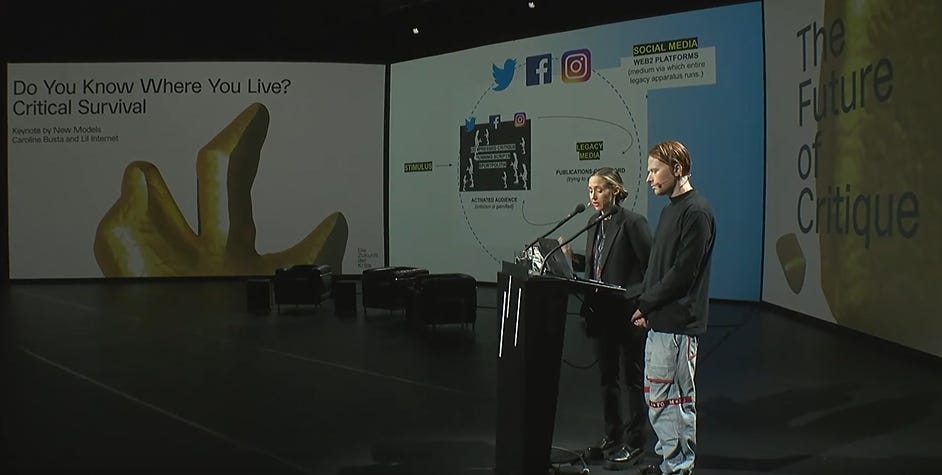
“We knew that one of the main problems was distribution,” Carly tells me. Writers were writing for less money and less visibility. There was a decline in the quality of written critique as well as an economic crisis that accelerated legacy media’s slipping hold on the public sphere. In their keynote speech The Future of Critique at Bundeskunsthalle Bonn in 2022, Carly states;
We see a decline in journalistic quality as good writers literally can’t afford to take on assignments at the going rate, a massive brain drain from the industry, and a critically weakened discourse. Elite journalists start to migrate attention towards social media where vetted critique is replaced by criticism compressed by platform guidelines into easily misunderstood buzzwords, slogans, and infographics. Audience capture comes into play, as the critic or the writer is forced to prioritize subject matter that maximizes attention, retains or pleases an existing audience, and especially does not jeopardize their reputation, or worse, their following.”
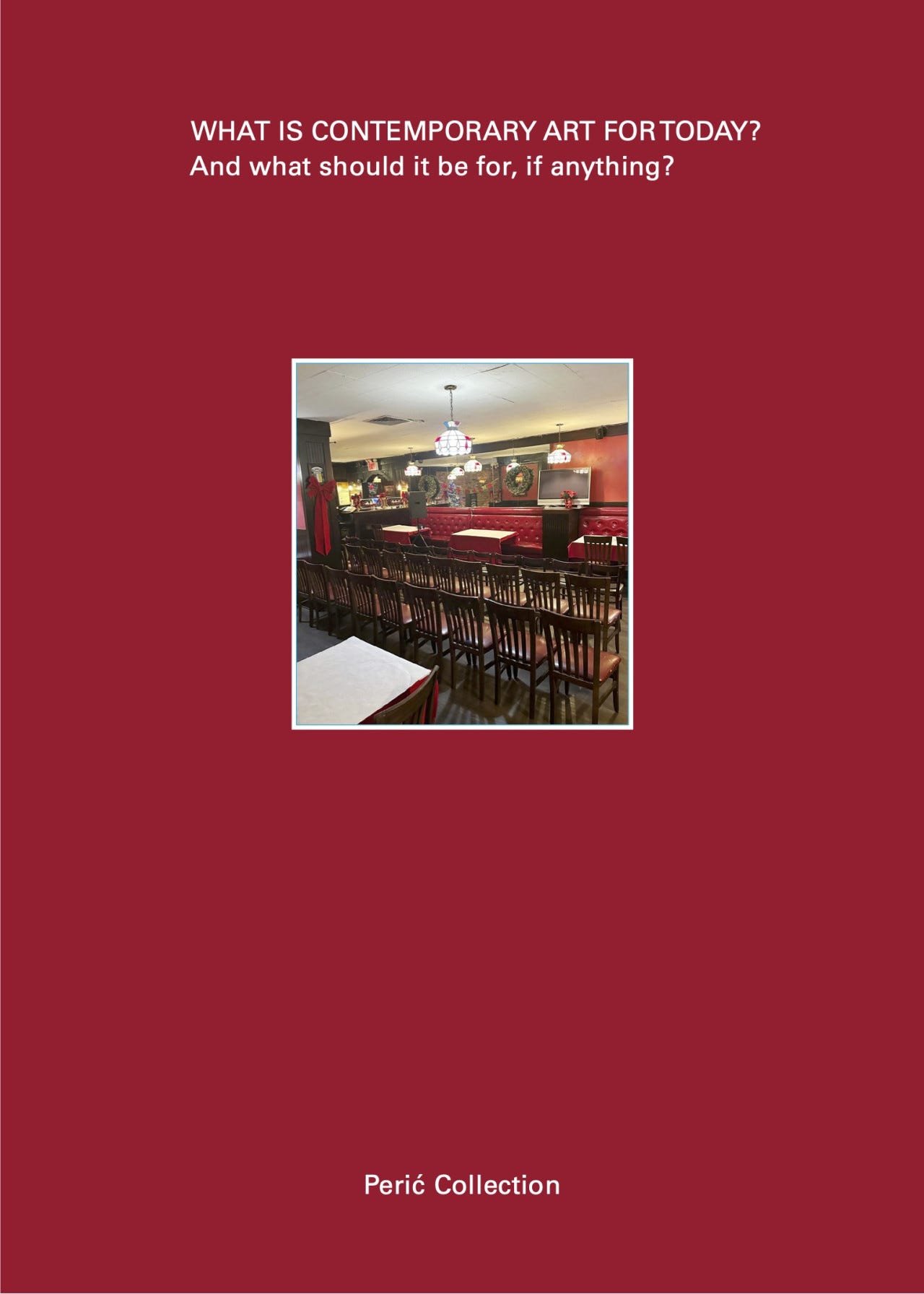
In an essay by Ben Davis, included in the collection “What Is Contemporary Art For Today?” excerpted on the NM Podcast in August of this year, Davis recounts his experience writing about art in the early 2000s, when any art show in a gallery was a potential subject, and an essay on a show might run months after its closing. “Now, everything is relentlessly present oriented,” Davis writes, “pitched at the current moment, which also means that there is less room for writers to respond to each other over time so that a work accumulates durable meaning.” Finding meaning used to be the job of the art critic, but now, Davis writes, “There is a general breakdown of the sense that art is meaningful.” Speaking at Bundeskunsthalle Bonn in 2022, Carly refers to our platform/protocol-ruled media sphere as an environment “where no work is truly valued and no one can truly think.” If declining professional opportunities and worsening financial prospects were not enough to bring a writer to turn their backs on the institutions, the devaluing of the search for meaning just might be.

This shift in the “physics” as Lil Internet calls it, of media consumption and the lifecycle of content is best understood by holistically mapping the landscape of the public sphere. Carly and Lil Internet begin with the 1785 Paris Salon that Thomas Crowe described as “a bringing together of a broad mix of classes and social types, where exhibitions were faced with the task of defining what sort of public it had brought into being.” From this locus for public discourse emerges the art critic, whose task is to triangulate the work in question with the zeitgeist of its public viewers and any relevant public, political, or economic conditions. “In linear media,” Carly explains, “there’s a very clear attention zone, and this zone is valuable for everyone involved. It exists as an energy point within a shared common space or public sphere.” Quoting Nancy Frazier’s 1990 essay Rethinking the Public Sphere, Carly qualifies that a public sphere for discourse “is not an arena of market relations, but rather one of discursive relations, a theater for debating and deliberating rather than buying and selling.”
But by the early 2010’s there was a tectonic shift in content dissemination as smartphones became ubiquitous. Suddenly, the mainstream is divided into infinite small streams that erode the credibility of gatekept media and its melting public sphere. The new “physics” of public discourse, forced to acquiesce to social media guidelines, become antithetical to the definition of a public sphere as defined by Nancy Frazier. This is because, as Carly explains;
“social media is, by its structure, built around attention and market relations. We are not private persons in this space. Platform physics and gamification require us to align with the platform’s interests, and any activity going against the platform’s interests will punish the offending user with warning, shadow banning, deleted posts, suspensions, or full out bans.”
Lil Internet defines these dominant platform physics as: “the affordances, limitations, and laws that govern traction, speed, visibility and even permanence of an idea or a piece of content.” In practice, this looks like the user interface design of a platform, the uniformity of how posts appear, character limits, the platform’s gamified mechanics and incentives, all predicated on the platform’s recommendation algorithms, increasing engagement whether positive or negative. It’s important to recognize that our cognitive and emotional systems are a part of these social media physics. Lil Internet continues, “they include releases of dopamine, cortisol and adrenaline, as well as crowd dynamics and peer pressure of all kinds, which have a major hand in the “mis-, dis-, and mal- information boom.” And when the physics of these platforms shapes everything within it and emerging from it, Lil Internet argues, “critique and discourse will always be compressed and compromised.”
If a map of the public sphere centered around top down media structures looked something like a glacier, an updated map that plots our current media landscape looks more like Benjamin Bratton’s The Stack, Lil Internet explains. There is no longer a shared physical room, or any identifiable landmark origin of a signal, but “layers of physical and digital containers and protocols that together give the illusion of a shared digital space. It is fundamentally not linear. It is holographic, or perhaps even just the kind of amorphous slime or lubricant that allows information to be transmitted across the layers.”
Carly speaks from her background in magazines to explain that adding a Discord channel to the NEW MODELS structure was important because “editors don’t make magazines, they make audiences. And a magazine or a podcast alone is no longer the way to do that. It has to be something more cybernetic.” She paraphrases theories from K Allado McDowell’s 2024 text Neural Interpellation to explain that “when we went from broadcast media to network media, the role of content changed. The job of content is no longer to transmit information.” She says, instead, “the job is to elicit responses, elicit engagement. And it’s through that engagement that the content gains meaning. The meaning of content under web 2.0 network media is in the hands of the audience, and it is only at that point that it gains value. A one way signal was just going to fall flat. The real thing we were building was not a podcast, but a community.”
So what are the physics of NEW MODELS? It’s always developing. The core NM structure is simple; users pay €5 a month on Patreon or Substack to access the full NM archive. How long they spend or don’t spend on the site doesn’t threaten the platform’s stability. Discord users pay €8 a month on Patreon to chat and collaborate with other members. The space is curated and well moderated. Shared funds are allotted for various community projects. Its members contribute to a new discursive sphere, and through their participation, feed into the podcast programming and the logic of the aggregator page with which the project first began. Carly and Lil Internet share that new guests on the show are often people they first encounter in the server.
“In the beginning, it was very much about building a life raft,” Carly says, “a place outside of the crumbling institutions to continue a conversation. I always thought that a time would come when we would be invited back into the institutions to build or rethink institutional structures, and that has kind of started to happen now, but New-Models-as-life-raft continues to exist. I imagine in the future New Models will evolve, but right now it’s serving its purpose as the corner bar.”
“Dinner Party,” Lil Internet says.
“Dinner Party,” Carly agrees, “it’s a place,” she says, “a spatial place.” NM is largely virtual, but also devirtualizes in the way of an IRL channel on the server, and usually at least one large IRL New Models event annually. They mention FOMO as we discuss IRL meetups, and how the fear of missing out is how the real reminds the simulated which one truly has higher resolution. They tell me that some NM members even attended their daughter’s first birthday party.
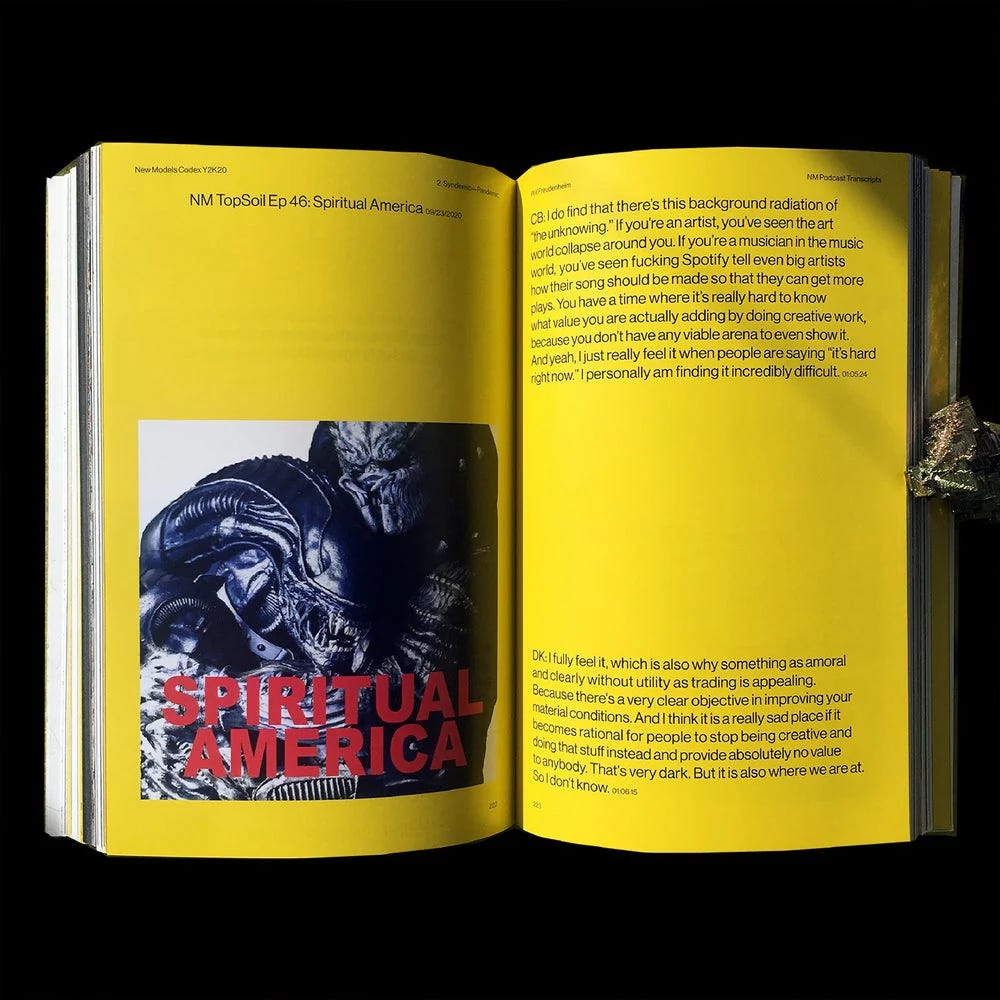
Carly calls New Models a neutralizing force, a neutral space that exists in contrast to the media landscape that compelled them to start it, and Lil Internet adds that cortisol- and adrenaline-inducing content, is generally banned in the server. Carly holds up the New Models Codex, NM CODEX Y2K20, a physical book she calls, “the internet devirtualized.” It is a collective distillation of New Models member contributions from 2020 filtered and produced by the New Models community. In 2020, NM member Leïth Benkhedda, who has since helped to manage the New Models server, posed the idea of making a COVID yearbook. Members self-organized into teams to solicit and edit contributions, and to write code to scrape the server and filter it with a permission system that allowed members to opt in or out of their content being published, and then to indicate what degree of authorship/anonymity they required. New Models funded the book’s production and then distributed net profits to the contributors through a member-devised payment system. “It was really an exercise in direct democracy,” Carly says, “and one that maybe only COVID could have enabled,” she laughs. “The role of print has changed,” she adds, yellow Codex in hand, “it’s no longer to transmit, it is to archive. And this is an archive of a year being extremely online.”
In a New Models podcast episode from August 2023, Psyberspace (NM68), artist Trevor Paglen calls the project “a revitalizing force”. They discuss Paglen’s works with UFOs and UAPs, and Carly quotes Paglen from a booklet he created contextualizing works he had on view at the time at Neuer Berliner Kunstverein (n.b.k.) in Berlin: “We live in a world of relentless influence operations. We are racing through the world of surveillance capitalism into an era of psyops capitalism.” Trevor responds to situate these works within the media environment, “an attention economy of likes and clicks where the product is your fingerprint,” and wherein “a media landscape that is specifically tailored for you is on the horizon.” Paglen discusses stealth and the Palladium Program, in which US operatives created objects that could look like a number of different things when interacting with different sensor systems. They discuss the weaponization of perception and the role US intelligence operatives played in creating 20th century mythologies of UFOs. In discussing myth, Carly asks if perhaps the lack of a myth strong enough to create mass upheaval is why empirical data, such as global warming, stops being shocking and becomes banal. Paglen suggests that maybe raw data is antimythological.
Maybe in some ways discourse functions like myth. In creating a place for curation and critical discourse, perhaps myth and narrative can reemerge. If legacy media is a melting glacier, and social media is a placeless cloud, perhaps New Models is a lush valley, an open underground protected from the signal scrambling weather beyond its edges. It acts like a terrestrial speaker, amplifying the sounds of those who come from the dark forests. When a glacier melts, new streams carve a fresh face into the Earth.
Devirtualize was coined in 2018 by Jak Ritger, an artist and writer. He is a long time contributor to New Models and Do Not Research.
 | A guest post by
|
 | A guest post by
|